Friday, May 3, 2013

Where in Melbourne Puzzle - May 2013


Where in Melbourne Puzzle - May  2013.
 
THIS PUZZLE HAS BEEN REVEALED


Clue 1 - Carved between 1931 and 1934, many children have seen it.


Clue 2 - "... the old sorcerer spider in his large web is still weaving fantastic shapes and humming strange mystic tunes, always working and never being still ..."
just a short walk from the city


Clue 3 - Only a stroll away from Shakespeare's House.


Clue 4 -

"I have carved in a tree in the gardens for you, and the fairies,
but mostly for the fairies and those who believe in them,
for they will understand how necessary it is to have a fairy sanctuary.
A place that is sacred and safe as a home should be to all living creatures."
                                                                                                                
                                                                                                                       - Ola Cohn

SOLUTION REVEALED
 
The May 2013 puzzle is an image of the Fairies Tree in Fitzroy Gardens, Melbourne.
  
Where in Melbourne Puzzle May 2013 revealed
The Fairies' tree - plaque
 THE FAIRIES' TREE
CARVED BY OLA COHN, M.B.E., A.R.C.A
FROM 1931 - 34
A GIFT TO THE CHILDREN OF MELBOURNE
FOREWORD FROM HER BOOK "THE FAIRIES' TREE"
I HAVE CARVED A TREE IN THE FITZROY GARDENS FOR YOU
AND THE FAIRIES, BUT MOSTLY FOR THE FAIRIES. AND THOSE
WHO BELIEVE IN THEM, FOR THEY WILL UNDERSTAND HOW
NECESSARY IT IS TO HAVE A FAIRY SANCTUARY - A PLACE
THAT IS SACRED AND SAFE AS A HOME SHOULD BE TO
ALL LIVING CREATURES.
THEREFORE I DEDICATE THIS BOOK TO CHILDREN AND FAIRIES
AS IT IS TO THEM I OWE MY INSPIRATION.
MELBOURNE 23 MAY 1932 OLA COHN
  
The Fairies' tree - East side
The Fairies' tree - North side
The Fairies' tree - Fitzroy Gardens
The Fairies' tree story has been put most eloquently by Walter Jago.

A FAIRY TREE.
Carved, by a Woman.
TREASURE FOR CHILDREN.
(BY WALTER JAGO.)
 
"Miss Cohn was born in Victoria. She went to London to study, and returned with her degree from the Royal College of Art. She returned also with the inspiration to give the children of Melbourne a Fairy Tree.

In the Fitzroy Gardens stood a tall stump of red gum, said to be 700 years old. It was stark and unsightly, and might any day have been grubbed out.
 
But now it is a monument, guarded by the City Council, cherished by the people, for Miss Cohn has materialised her dream by turning the stump into the Fairy Tree. On half the surface for about ten feet high she has carved a multitude of animals, birds, insects, reptiles, fairies, and imps. Ivy, growing to the top, covers the other half.

There is a story connected with each character, and the old sorcerer spider in his large web is still wearing fantastic shapes and humming strange mystic tunes, always working and never being still, but the web is a friendly playground for the fairies who swing from the heavy strands and turn somersaults.
 
An opossum, hanging by his tall from a knot of the tree, watches them with envy, for the web is not strong enough for him. The imps are not so fortunate, and one has been caught in the web. He is held there until Stoutheart comes with his magic bulrush, and charging on his gallant frog, forces the wicked sorcerer to flee.

Stoutheart is the Australian Peter Pan. He is the joy and pride and protector of every fairy and imp. He keeps the Sneaky Snake in check, and if It wasn't for Stoutheart the snake would sneak out of the knot-hole and devour a grand old frog. But with Stoutheart about the frog just looks out of the corner of his eye and smiles, and has no fear.
 

In carving the fairy story Into the tree she used the natural shape of the trunk economically, and all the irregularities yielded to her chisel to pro- vide the forms she wanted. For three years she worked to turn the dead stump into a living universe, and then, as though to acknowledge her achievement, a swarm of bees came and filled the old hollow trunk with golden honey."

Fairies' Tree, Fitzroy Gardens.


Research Links

East Melbourne Historical Society - catalogue

East Melbourne Historical Society - catalogue images

National Portrait Gallery

Wikipedia

Only Melbourne

Trove
 
The next Where in Melbourne Puzzle will be published on 3rd June 2013.
 
This page was last updated on the 27th of May.


Monday, April 1, 2013

Where in Melbourne Puzzle - April 2013

Where in Melbourne Puzzle - April 2013.

THIS PUZZLE HAS BEEN REVEALED

DIFFICULTY LEVEL


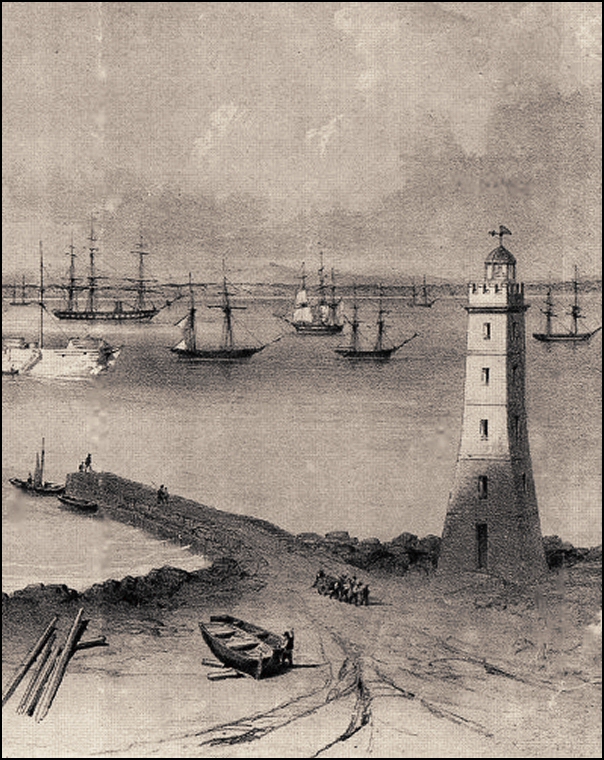
Clue 1 - Originally erected as a timber structure in 1839, it was the first of its kind in Victoria.


Clue 2 - This is a heritage listed site. The location served  a number of early government activities related to defence and the penal system, as well as the first astronomical observatory in the Colony.


Clue 3 - The building has had a unique function of accuracy and still operates today, but it is no longer relied on as it once was. The site also included the first defensive shore battery to protect Melbourne from attack by hostile warships and a of the first telegraph station in Australia.


Clue 4 - The tower's unique feature is a large copper sphere mechanism mounted around a mast.


SOLUTION
 
"... and a beacon or tower should be erected at this point ..."
 
Governor Bourke, 1837

Williamstown time ball tower

History

The original lighthouse was constructed in 1840, right on the point of Gellibrand's Point. It is most likely Victoria's first navigational aid of any distinction, though an unlit beacon had been on the site since 1835. It also may have been the first harbour light of its kind in Australia.
 
It was timber skeletal structure on a bluestone base with a fixed white light and claimed a visibility of 5 leagues (approx 15 miles).
 
The cost of construction was £50 (£500?). A further £85 was allocated for the annual wage of the Keeper.
 
In 1848, tenders were called for a new lighthouse on Gellibrand's Point - this is the bluestone section of the tower that remains today.
 
The successful tenderer was James Linacre who built the bluestone lighthouse in 1849 at a cost of £925. With the tower there was also accompanying timber keepers' quarters. It commenced operations in 1849.
 
It is interesting to note that the old lighthouse was advertised for removal by auction 'as is' a month after the new light commenced.
 
It appears that the second light may have been red in colour.
 
The second light operated until 1859 when it was replaced by a floating lightship anchored off the point in 4.5 fathoms of water.
 
The tower was yet to become a lighthouse again in 1934, but not before it served in an interesting role as a time ball tower.
 
In 1853, a Mr R. L. J. Ellery, the first Government Astronomer, commenced determining accurate local mean time, and established a time ball so that shipmasters to correct their chronometers "at the fall of the ball" at exactly one o'clock each day.

A time ball was a large copper sphere mounted around a mast.
 
After the discontinuing of the bluestone tower as a lighthouse, the time ball mechanism was moved to the top of the tower around 1860. It is definitely known to have been operating there in 1861.
 
The time ball operated from then until 1926 when the keeper fell ill and died. By then most ships had the more advanced technology of wireless communication time-signals. It is said that when the time ball was turned off not one person in Melbourne even noticed!


By 1934 the time ball had been removed. In this year the bluestone tower was extended by 30 feet with a circular brick tower on top. The extension was then painted with a coat of aluminium paint.
 
The tower operated as a lighthouse from 1934 to 1987. It is believed the lighthouse was re-established due to the loss of singularity against the light of the City behind the Point Gellibrand Pile Light.
 
It was electric, gave a green and red light and had a visibility of 15 nautical miles.

The Time Ball Tower, Williamstown, 1985 by Rick Amor (born 1948) 

oil on canvas
70.5 x 91 cm
signed and dated lower left: RICK AMOR '85
Sold for $9,600 in Auction 2 - 29 August 2007, Melbourne

Between 1987 and 1989, the brick extension was demolished and a functional new replica time ball mechanism was reinstalled restored by the Point Gellibrand Rotary Club to commemorate the history of the site. This was officially opened in 1990.
 
Under threat of subdivision and redevelopment the whole site was declared an historical site by the Premier, Steve Bracks, in 2000.
 
The tower today is operated by a computer, which drops each day at 1pm as when it was in the 19th and early 20th centuries. 

 Information sign at the Williamstown Ball Tower.


 Location Satellite.

research links 

 Next Where in Melbourne puzzle will be published on Wednesday 1st of May 2013.

This page was last updated on the 22nd of April 2013

Monday, March 4, 2013

Where in Melbourne Puzzle - March 2013

 
Where in Melbourne Puzzle - March 2013.


THIS PUZZLE HAS BEEN SOLVED


DIFFICULTY LEVEL


Clue 1 - Many favour this spot to take pictures of Melbourne.

* * *
 
 
Clue 2 - Completed in 1899 by John Monash and J.T.N. Anderson,
the name was changed in 1936 after the Lord Mayor of Melbourne (1926 - 1928).

* * *
 
! This puzzle is now solved !

Congratulations Mark

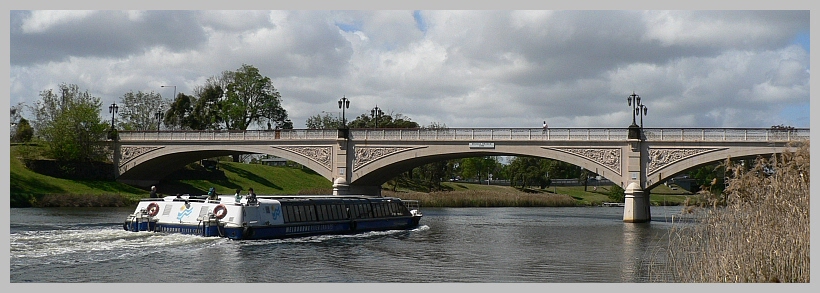
for correctly identifying the location to be the Morell Bridge in South Yarra.


Your Winner's certificate is on the way,
 
Remaining Picture Clues
 
 
Clue 3


Clue 4


Solve - Morell Bridge, South Yarra


Morell Bridge offers one of the more spectacular views of Melbourne.

BRIEF HISTORY

Morell Bridge as seen in Google Earth

The Morell Bridge is a bridge over the Yarra River in South Yarra.

It  was completed in 1899 1899 by the firm of Monash and Anderson using the Monier concrete construction technique. The Monier system of construction was patented in 1867 by Joseph Monier, a French manufacturer of garden ware.

Joseph Monier 1823 - 1906
Monier used a grid of small-diameter iron bars embedded in a coarse mortar especially for the construction of planter pots. The technique and patents were gradually extended to cover, amongst other things, arch bridges.
 
Monash and Anderson operated as the Victorian agency of the Sydney based engineering and contracting firm of Carter Gummow & Co, who held the Australian patent for the Monier technique. JTN Anderson from Monash and Anderson supervised the construction of the bridge with the design attributed to WG Baltzer, from Carter Gummow & Co. The bridge was erected on dry land and upon completion the Yarra River was diverted under it.

Anderson Bridge under construction
It features decorations on the three arch spans, including large dragon motifs and ornamental Victorian lights.  The reinforced concrete arches are filled with earth.
 
The 102 metre long bridge is divided into three equal spans, with concrete abutments and piers. The concrete surfaces are finished with cement mortar and and handrails are of cast iron. Each pier is mounted by a light standard containing twin lamps.
 
The Bridge is listed on the Victorian Heritage Register.

Sir Stephen Morell
Originally known as the Anderson Street bridge, In May 1936 the bridge was named after Sir Stephen Morell, Lord Mayor of Melbourne between 1926 and 1928, as a tribute to his municipal service and enthusiasm for rowing.
 
On June 7, 1998 the bridge was closed to motor vehicles as part of the City Link project. It is currently used by cyclist and pedestrian traffic, connecting the Royal Botanic Gardens to the Olympic Park precinct. 

 
Sources


GoogleEarth 
History of Australian rowing
Australian dictionary of Biography
Victorian Heritage Rregister
Morell Bridge
Joseph Monier

The next Where in Melbourne puzzle will be posted April 1st 2013.

Page last updated 13 March 2013.

Monday, January 28, 2013

Where in Melbourne Puzzle - February 2013


Where in Melbourne Puzzle - February 2013.

THIS PUZZLE HAS BEEN REVEALED
 

DIFFICULTY LEVEL


Clue 1 - The clue is in the picture.


Clue 2 - The tram is a model C.3034
and it is passing one of only 8 locations like it in Melbourne.


Clue 3 - You can get to North Balwyn, La Trobe Street, Docklands,
Port Melbourne and Box hill from here


Clue 4 - There are 8 tram depots in Melbourne catering for one of the worlds most extensive tram networks. This one is located East of the City.


Clue 5 - Reveal


Solution : The Kew Tram Depot in Barkers Road Kew. It is used to house and maintain trams.


A brief history of Melbourne trams.

Melbourne's first tram was a horse tram from Fairfield railway station to a real estate development in Thornbury, it opened on 20 December 1884, and was closed by 1890.
 
In 1888, the first electric tram was demonstrated during the Centennial International Exhibition, held at the Exhibition Buildings. Visitors to the Exhibition had the unique opportunity to ride on an electric tram less than twelve months after the technology had been perfected in America.
 
Although the people of Melbourne had enjoyed the novelty of cable trams for three years, the primitive open electric tram carried nearly seventeen thousand passengers along a 274 metre track at threepence per ride.
 
Box Hill to Doncaster tram
 The Doncaster tram was the first electric tram
in the Southern Hemisphere operating a regular service.

Doncaster Tower
The tram service between Box Hill and Doncaster
operated from October 1889 to January 1896.
 
The Melbourne cable tramway system operated from 1885 to 1940. The system grew to about 75 kilometres of double track and 1200 cars and trailers on 17 radiating routes from the centre of Melbourne to neighbouring suburbs.
 
Brighton Road Tram
Centennial Tram
Picture Ben Healley
Dummy motor' or grip car model
The 'dummy' contained the mechanism that gripped
the moving underground cable and gave each tram its motion.

In February 1923, after a lengthy planning process to expediate the conversion of Melbourne's cable tram system to electric traction, the General Scheme was submitted for aproval by the minister for Public Works.
General Scheme
Cable tram lines were progressively converted to electric trams with the last Melbourne cable tram operating on 26 October 1940.
 
C Class tram heading to Kew Depot
Today's Melbourne tram network interesting facts :
 
Currently, Melbourne has the biggest operating tram network in the world with 250 kilometres of double track.
 
There are 1763 tram stops across the network. 29 tram routes and the free City Circle tourist tram.
 
Annual patronage for 2011-12 was 191.6 million boardings
 
Melbourne trams travel more than 24.6 million kilometres each year.
 
31,500 tram services are scheduled each week.

There are 487 trams in the fleet run by Yarra Trams and range
from modern low floor vehicles to the iconic W Class -

70 A Class
132 B Class
36 three section C Class low floor Citadis
5 five section C2 Class "Bumblebee" low floor Citadis
38 three section D Class low floor Combino
21 five section D Class low floor Combino
38 W Class
147 Z Class

Kew Tram Depot as seen in Google Earth

Research Links

Yarra Trams
Engineering Heritage Victoria
Artistfootsteps
Wikimedia Commons
Melbourne Museum
Wikipedia

This page was last updater 25.02.2013.